

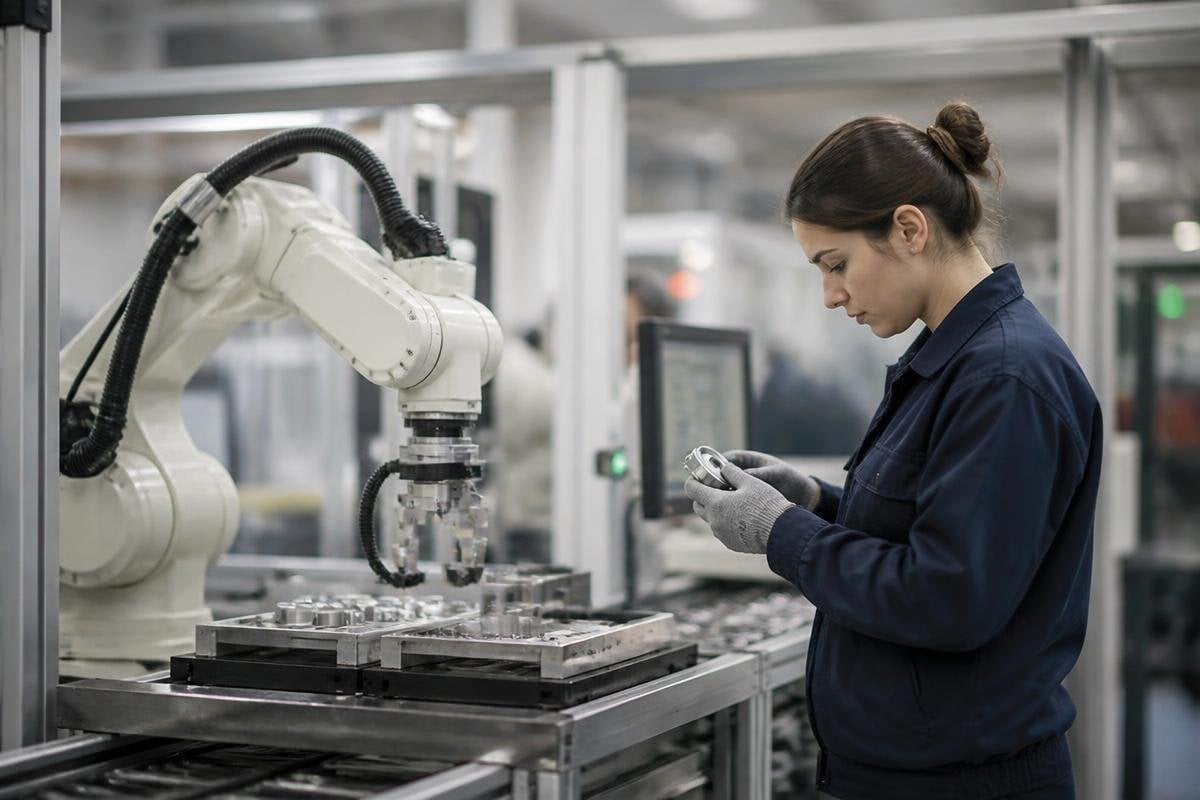
A robot can repeat a fixed movement for hours, while a person can judge an odd part, handle a customer, or change the plan. That difference makes job loss harder to measure than counting robots on a factory floor.
For anyone deciding how automation may affect their work, the useful question is narrower: which tasks can a machine do, and which parts still need a person?
Quick read
- Robots usually take on repeatable tasks before they remove a whole job.
- Jobs with varied work can change without disappearing.
- New roles depend on who runs, repairs, checks, and buys the machines.
A job is a bundle of tasks
Most jobs contain several kinds of work. A warehouse worker may move items, read labels, fix stock errors, and answer a colleague’s question. One machine may handle one part of that work while the person keeps the rest.
This matters because a machine can be useful without replacing the person beside it. A mobile robot can carry a load across a site, while a worker decides where unusual items belong. The robot arm can repeat a pick-and-place motion, while a technician deals with parts that arrive in the wrong position.
The work may still change. A person who once spent most of a shift moving items may spend more time checking exceptions, loading software settings, or fixing a blocked route. The job title can stay the same while the daily work shifts around it.
Where robots have a clearer path
Robots fit tasks with fixed steps, steady objects, and a controlled setting. These conditions make it easier to set rules for motion, safety, and error handling.
A task becomes harder when the robot must deal with changing shapes, weak signals, crowded spaces, or a result that is hard to measure.
Picking one known part from a fixed tray is easier than sorting damaged goods from a mixed pile. Driving across a marked floor is easier than working through a busy site with people, carts, and loose material.
That gap explains why a robot demo can look ready before the wider job is ready. A short test may show the machine doing one task under set conditions. Real work adds delays, damaged parts, safety checks, software faults, and requests that were not in the test plan.
A report from Robot 24 can place the machine and its work setting beside a job claim. That gives you a clearer way to ask what changed for workers and which new duties appeared around the machine.
The new work around machines
Automation can remove some tasks and create other work around the system. Someone has to install the robot, connect its sensors, check its safety settings, review its logs, and repair faults.
That does not mean every lost task turns into an equal new job. A small team may run a system that once needed many people. The result depends on the machine’s price, the task it handles, the work site, and the skills available nearby.
I think the honest answer is that robots will change more jobs than they erase in one move, while some roles will still disappear where a machine can handle nearly every step at a lower cost.
The open question is who gets time and training before that change reaches their work. A company may gain from a robot, while a worker carries the cost of learning a new role or finding a different one.
A practical check before you judge the risk
Use these questions when a company says a robot will replace workers:
- Name the task: Which exact movement, decision, or handoff will the robot do?
- Check the setting: Does the machine work only in a controlled test area?
- Find the exception plan: Who handles damaged goods, blocked paths, or sensor faults?
- Count the people left: Who loads, watches, repairs, and approves the system?
- Check the time frame: Is this a demo, a pilot, or routine work across a full shift?
- Ask about training: What new skills will current workers need, and who pays for them?
These answers give you a better view than a robot count. A site with ten robots may still need many people if the machines handle narrow tasks. A single system may remove more work if it covers most steps in a fixed process.
Robots will take some jobs where the work is stable, repeatable, and easy to check. For many other jobs, the nearer change is a new task list, with the hardest issue being whether people get a fair chance to move with it.
